By Our Correspondent
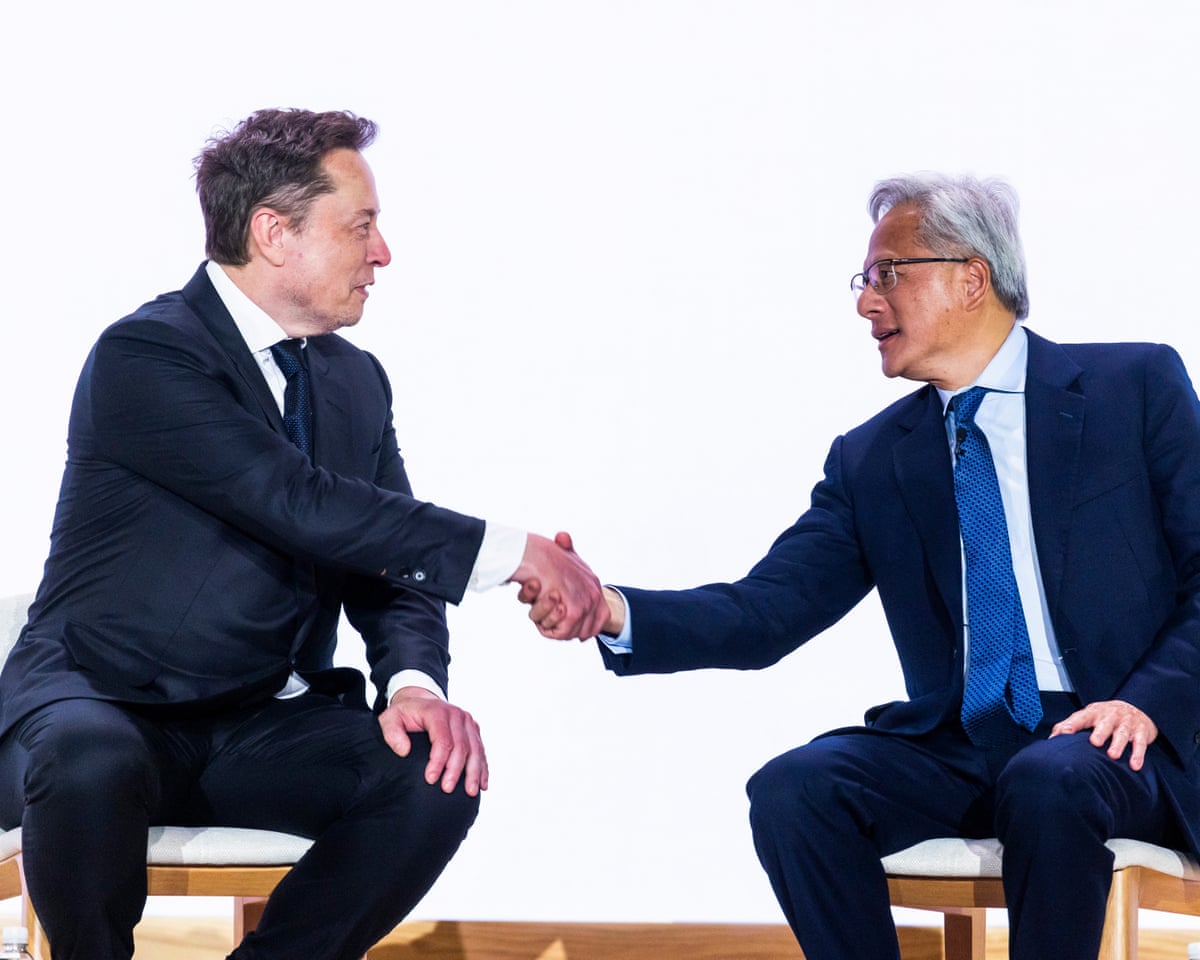
Elon Musk and more than 165,000 other signatories have called on Nvidia’s board of directors to reinstate its former Chief Executive Officer, Jensen Huang, following his resignation amid allegations of personal misconduct and concerns over the company’s dealings with China.
The signatories, comprising prominent technology executives, investors and Nvidia employees, made the demand in an open letter urging the company’s board to reconsider Huang’s departure while an independent investigation establishes the facts surrounding the allegations.
The letter specifically called on the board to “bring Jensen back while an independent investigation establishes the facts”.
Huang’s resignation on Thursday brought an end to his 33-year leadership of Nvidia, the artificial intelligence (AI) chipmaker he co-founded.
His departure followed reports alleging that he had engaged in at least two extramarital relationships, including one involving a woman accused of spying for China and another with a subordinate.
However, the Financial Times reported that Huang had discussed the possibility of returning to the company with people close to him.
According to the newspaper, an ally of the former chief executive said a group of Silicon Valley executives was assembling a so-called “war room” to mobilise support for his reinstatement.
The group was also reportedly considering seeking backing from the White House.
“Everyone that matters in tech outside the frontier labs loves Jensen,” the source was quoted as saying, adding that Huang was aware of and supported the initiative.
The campaign gained further momentum on Friday when two major investors, Brad Gerstner and Gavin Baker, urged Nvidia’s board to keep “all options” open regarding the company’s leadership.
However, United States Treasury Secretary, Scott Bessent, has expressed a different position, insisting that Nvidia should consider candidates from outside the company for its next chief executive.
Speaking on Fox News on Sunday, Bessent said the company needed a significant leadership shake-up.
He also urged Nvidia to clarify whether it knowingly allowed its most advanced artificial intelligence chips to reach China, arguing that the issue was more significant than the allegations concerning Huang’s relationship with an alleged Chinese spy, identified as Alice Huang.
The United States has imposed restrictions on the export of its most advanced AI chips to China as part of efforts to maintain its technological advantage over Beijing in the global artificial intelligence race.
Although President Donald Trump authorised the sale of Nvidia’s H200 chips to China in late 2025, the approval did not extend to the company’s most advanced processors used in developing sophisticated AI models.
“Nothing above the H200s can be sold to the Chinese,” Bessent said.
He added that investigations should establish whether Nvidia maintained an effective compliance culture regarding US export restrictions.
The Treasury secretary further disclosed that he expected answers from Nvidia and the outcome of its internal investigation into Huang’s conduct within 10 days.
Meanwhile, US lawmakers have called on the Trump administration to explain what it knew about Huang’s alleged relationship with the suspected Chinese intelligence operative.
Huang has reportedly agreed to appear before the House Select Committee on China, as well as the House Foreign Affairs and Intelligence committees.
The dates of the appearances, which are expected to take place behind closed doors, have yet to be announced.
Separately, Megaspeed, a Singapore-based company where Alice Huang served as an executive before leaving in 2025, said on Monday that it was a “legitimate and lawful business”.
The company was reportedly among Nvidia’s largest foreign customers over the past three years, purchasing nearly $5 billion worth of artificial intelligence chips and advanced hardware.
Among the prominent technology figures who signed the open letter supporting Huang’s return are Musk, Tim Sweeney, founder and Chief Executive Officer of video game publisher Epic Games, and Garry Tan, president of Y Combinator, a leading San Francisco-based business accelerator.
Travis Kalanick, co-founder of Uber and another signatory, acknowledged that Huang might have made mistakes but argued that the allegations did not warrant his removal from the company.
“Jensen has erred, yes – to err is to be human – but I do not believe anything he has done rises to the bar of separating him from his company,” Kalanick wrote.
More than 7,500 people who signed the letter identified themselves as Nvidia employees, representing approximately 18 per cent of the company’s workforce.
The scale of support underscores Huang’s influence within the global technology industry, where he is widely regarded as one of the most influential figures in the development of artificial intelligence.
Under his leadership, Nvidia evolved into a major force in the AI industry, with investments in data centres and technology start-ups helping to strengthen its position in the global market.
The company’s growing influence has earned it the nickname “the central bank of AI”, reflecting its central role in financing and powering the rapidly expanding artificial intelligence ecosystem.
About the Author