By Our Correspondent
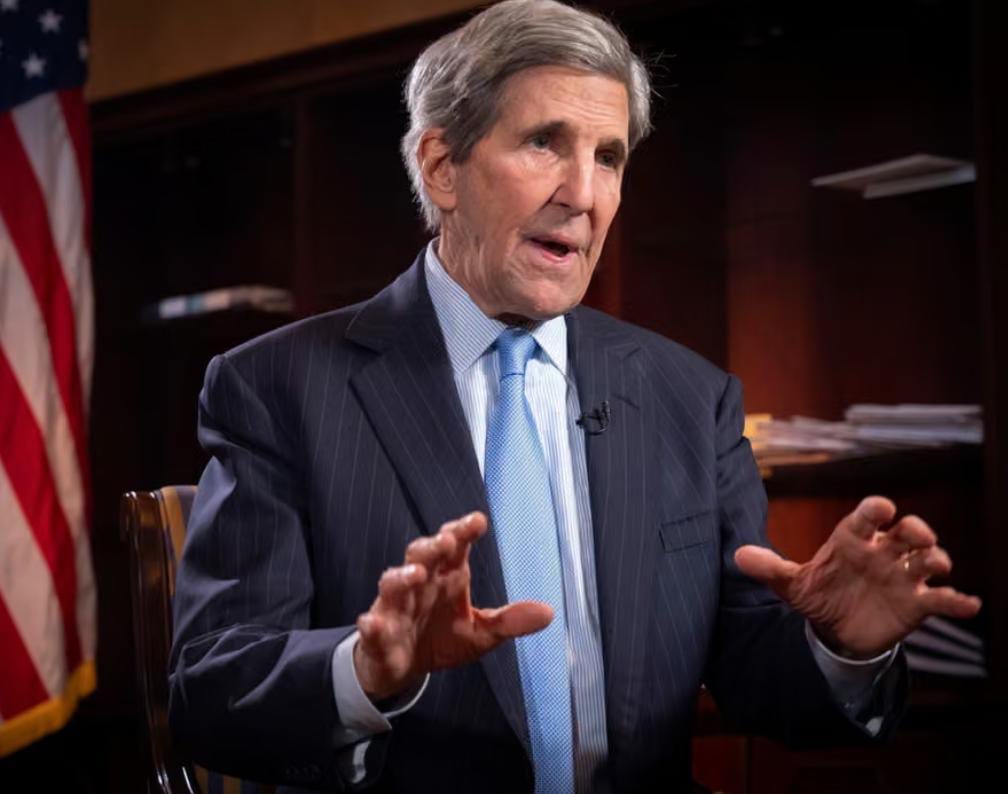
Former United States Secretary of State, John Kerry, has urged the US and other countries to follow China’s lead in renewable energy development, warning that failure to accelerate the transition to cleaner energy could undermine economic competitiveness, worsening the impact of climate change.
Kerry made the call in an interview with The Guardian as the 31st United Nations Climate Change Conference opened in Turkey, amid growing attention on China’s potential role in shaping global climate policy.
China has signalled its ambition to assume a greater leadership role in international climate efforts through its latest five-year plan, adopted in March 2026, in which it pledged for the first time to “actively participate in and lead global climate governance.”
The country has also consolidated its position as a major player in the global clean energy industry, with renewable energy technologies becoming an increasingly important contributor to its export economy.
In 2025, China’s clean technology exports exceeded $220 billion, with further growth projected this year. It accounts for approximately 85 per cent of global solar supply chain production capacity and 80 per cent of lithium-ion battery production capacity.
China also manufactured nearly 75 per cent of electric vehicles produced worldwide in 2025, strengthening its position as a leading supplier of clean energy technologies.
Analysts say the country’s growing dominance in the sector could boost its economic influence, strengthen diplomatic ties, particularly with developing nations, and shape international cooperation on climate change.
However, Kerry expressed concern that several countries, including the United States under President Donald Trump, were lagging behind in embracing the global energy transition.
He warned that continued dependence on fossil fuels could weaken national economies, reduce competitiveness and increase exposure to environmental threats.
“The only country that has hugely accelerated is China. The rest of the world is stumbling along while Mother Nature is sending us more powerful signals every week, every day,” he said.
Kerry explained that China’s push for renewable energy was partly motivated by concerns about its dependence on imported oil and gas.
He also pointed to disruptions in global energy supplies arising from the conflict involving Iran and interruptions to shipping through the Strait of Hormuz, saying such developments had compelled other countries to reconsider their energy security strategies.
He attributed the increased adoption of renewable energy in some countries to these developments, remarking sarcastically: “Thank you, Donald Trump.”
The former US diplomat maintained that the economic benefits of renewable energy would eventually encourage even authoritarian governments to adopt cleaner alternatives.
“They’ll see where the market is going, and they will recognise where the cheaper alternatives are. Even they can read a spreadsheet and understand where costs are exorbitant in fossil fuels and where you have a better deal,” he said.
He argued that renewable energy, supported by battery storage and transitional natural gas supplies, was becoming a more affordable and effective alternative to continued dependence on fossil fuels.
“The marketplace has made its decision and globally is moving to electrons, and electrostate status. People are going to electricity and they’re going to try to do that as clean as humanly possible.
“That is the choice that I see being implemented in many different places. It is unstoppable,” Kerry added.
Meanwhile, China has indicated that the unrestricted movement of green technologies would be a major issue in its international engagements, particularly amid escalating geopolitical tensions and trade disputes.
The position is widely viewed as a response to tariffs imposed by the United States and the European Union on Chinese-made electric vehicles, solar products and other clean energy technologies.
Commenting on China’s expanding influence, Li Shuo of the Asia Society Policy Institute said the country’s growing presence in the global clean energy market had placed it at a critical point in determining the future of international climate cooperation.
He noted that the changing relationship between economic growth and climate action presented China with an opportunity to pursue a greater leadership role.
“In a world where climate action was once seen as a constraint on growth but is now increasingly a driver of it, China faces a singular question: will it step into a leadership role not out of obligation, but out of self-interest,” he queried.
About the Author