By Sam Adah
The Minister of Marine and Blue Economy, Adegboyega Oyetola, has urged local and foreign investors, as well as financial institutions, to take advantage of the vast investment opportunities in Nigeria’s catfish industry, describing the country’s fish supply deficit as a major prospect for economic growth, job creation and food security.
Oyetola disclosed that Nigeria requires approximately 3.6 million metric tonnes of fish annually but produces only 1.4 million metric tonnes locally, leaving a supply gap of about 2.2 million metric tonnes.
He said the deficit presents an opportunity to expand domestic fish production, strengthen the fisheries value chain and reduce the country’s dependence on imported fish.
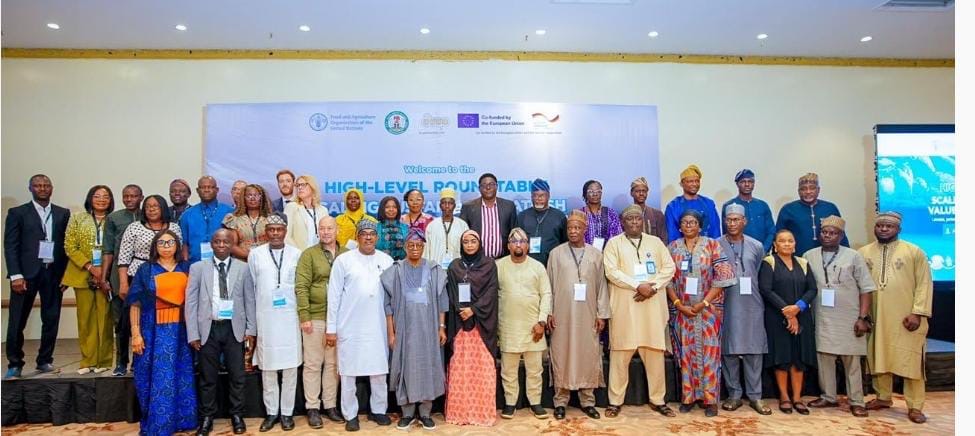
The minister made the call on Wednesday at a High-Level Roundtable on Scaling Sustainable Catfish Value Chain Transformation, organised under the Fisheries and Aquaculture for Africa, the Caribbean and the Pacific (FISH4ACP) programme.
He described increased domestic fish production as both an economic necessity and a food security priority, stressing that investment in the sector would strengthen food supplies, stimulate enterprise development and provide sustainable employment.
“Expanding domestic fish production is an economic and food security imperative. It offers an opportunity to strengthen domestic food supply, reduce dependence on fish imports, stimulate enterprise development and create sustainable livelihoods across the country,” he said.
Oyetola noted that Nigeria is Africa’s second-largest aquaculture producer and one of the continent’s leading producers of farmed African catfish.
He, however, stressed that the industry’s investment potential extends beyond fish farming to include hatcheries, feed mills, equipment manufacturing, transportation, processing, cold-chain facilities and distribution.
According to him, developing these interconnected segments would generate significant economic activities and create opportunities across multiple sectors.
“Investment in aquaculture has a multiplier effect, creating opportunities and value across several interconnected sectors of the economy,” he stated.
The minister maintained that closing Nigeria’s fish production gap would require coordinated investment across the entire aquaculture value chain rather than simply establishing more fish farms.
He identified access to quality fingerlings, affordable feed, appropriate financing, effective fish health management, reliable markets and modern infrastructure as essential requirements for sustainable industry growth.
Oyetola also commended the Food and Agriculture Organisation (FAO), the European Union and the German Government for supporting the development of Nigeria’s catfish value chain through the FISH4ACP programme.
He said the initiative had helped identify critical challenges facing the industry while promoting interventions in alternative feed ingredients, including black soldier fly larvae, hatchery management, broodstock improvement, business development and digital farm management.
On access to finance, the minister urged financial institutions to introduce lending arrangements that reflect the operational realities and production cycles of aquaculture businesses.
He cautioned that inappropriate loan disbursement timelines and repayment schedules could undermine otherwise viable fish farming enterprises.
“The timing of disbursement, repayment schedules and cost of credit must reflect the production cycle and cash-flow patterns of fish farming enterprises,” he said.
Oyetola identified high feed and energy costs, inadequate supplies of quality fingerlings, poor fish health management, weak biosecurity practices and insufficient processing and cold-storage facilities as major constraints to the industry’s development.
He urged investors to view these challenges as business opportunities, particularly in commercial feed production, modern hatcheries, fish processing, cold-chain infrastructure, transportation and logistics.
The minister assured prospective investors of the Federal Government’s commitment to creating an enabling business environment through stronger collaboration with state governments, regulatory agencies and private sector operators.
He also pledged greater engagement with development finance institutions to facilitate affordable funding, improve industry data collection, promote research and strengthen quality assurance and technical support services.
To further enhance productivity, Oyetola advocated the establishment of aquaculture clusters and cooperative arrangements to lower production costs, encourage shared infrastructure and improve farmers’ access to essential services.
He equally called for increased participation of women and young people in the industry, particularly through small and medium-scale enterprises.
The minister stressed that the expansion of Nigeria’s aquaculture sector must be anchored on environmental sustainability, adding that a well-developed catfish value chain could make substantial contributions to economic development, employment generation and national food security.
About the Author