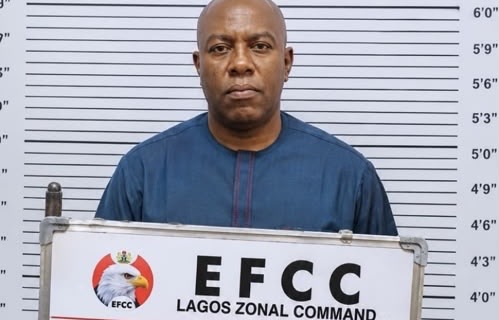
The Economic and Financial Crimes Commission (EFCC) has arraigned a businessman, Adonu Kingsley Ifeanyi, and his company, S Mobile Netzone Limited, before the Federal High Court in Lagos over an alleged financial fraud involving more than ₦12.5 billion.
The defendants were brought before Justice J. Bogoro at the Federal High Court, Ikoyi, Lagos, on Monday, November 2, 2026, by the EFCC’s Lagos Zonal Directorate 1.
According to the anti graft agency, the defendants are facing a five count charge bordering on alleged obtaining by false pretence, stealing and the handling of proceeds suspected to have originated from unlawful activities.
The total amount cited in the charges is ₦12,556,837,842, representing transactions allegedly linked to the defendants between 2020 and 2022.
One of the charges accused Ifeanyi of taking possession of ₦1,248,237,842 through an account bearing the name S Mobile Netzone Limited between June 4, 2021, and October 31, 2022. The EFCC alleged that the money represented proceeds of an unlawful activity involving obtaining by false pretence.
Another count accused him of receiving ₦6.79 billion through the company’s bank account between January 15, 2020, and April 14, 2022, which the prosecution alleged was connected to stealing.
The commission maintained that the transactions formed part of the alleged offences under the Money Laundering (Prohibition) Act, 2011, as amended.
When the charges were read to the defendants, both pleaded not guilty.
Following their pleas, prosecution counsel, Suleiman I. Suleiman, asked the court to fix a date for the commencement of trial.
Justice Bogoro subsequently granted the defendants bail on the same terms and conditions earlier granted by Justice C. J. Aneke on July 8, 2025.
The case is expected to proceed to trial, where the prosecution will be required to establish its allegations against the defendants.
The arraignment marks another major financial crime case before the Lagos division of the Federal High Court, with the EFCC seeking to prove its claims over the disputed transactions.
The defendants remain presumed innocent unless and until proven guilty by the court.
About the Author