By Mark Aba
A new three-volume authorised biography of former President Muhammadu Buhari, aimed at providing a comprehensive account of his life, political career and leadership legacy, will be presented to the public in Abuja on the November 17, 2026.
Former President Goodluck Ebele Jonathan is expected to unveil the publication, titled Buhari: ‘The Authorised Biography,’ while former President of Niger Republic, Mahamadou Issoufou, will chair the occasion.
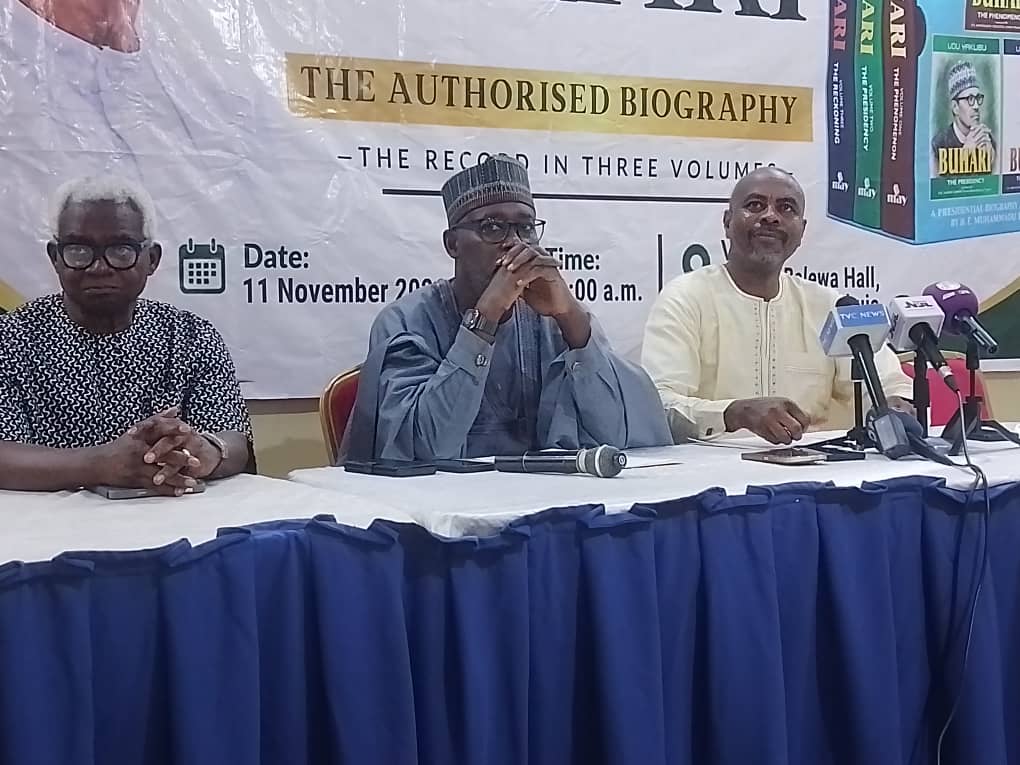
The biography was unveiled on Wednesday, November 11, 2026, during a press conference at Tafawa Balewa Hall, NICON Luxury Hotel, Abuja, where the author and Chief Biographer, Dr. Udu Yakubu, explained the motivation, research process and objectives behind the project.
Yakubu disclosed that the publication was the product of more than two years of extensive research, involving interviews, writing, editing, fact-checking and revisions.
He explained that documenting Buhari’s life required a broader historical perspective, given his involvement in different phases of Nigeria’s political development, spanning military rule, democratic governance, the Civil War, economic crises, opposition politics and presidential leadership.
According to him, different generations of Nigerians have encountered different versions of Buhari: the young military officer, the controversial military Head of State between 1983 and 1985, the persistent opposition politician who contested repeatedly for the presidency, and the civilian President who governed Nigeria from 2015 to 2023.
“All these Buharis belonged to the same life, the same person. The challenge was to understand how,” Yakubu said.
He explained that the biography sought to examine how Buhari evolved from his early years in Daura to military service and eventually democratic politics, as well as the circumstances surrounding his return to power through the ballot box in 2015, three decades after his removal from office.
Yakubu said the complexity of Buhari’s life and political journey informed the decision to produce the biography in three volumes.
The first volume, The Phenomenon, traces Buhari’s life from his ancestry and childhood through his military career, the Nigerian Civil War, governorship, petroleum administration, emergence as Head of State, overthrow and detention, and eventual return to democratic politics, culminating in his 2015 presidential victory.
The second volume, The Presidency, examines Buhari’s administration between 2015 and 2023, focusing on the institutions, key personalities, policy decisions, political pressures and national challenges that shaped his eight years in office.
The third volume, The Reckoning, evaluates the major issues that will continue to shape assessments of Buhari’s legacy, including national security, the economy, infrastructure, anti-corruption efforts, governance, foreign relations, social policy, institutional reforms, national cohesion and leadership.
Yakubu emphasised that although Buhari authorised the biography before his death, the arrangement did not compromise the independence of the author or the objectivity of the research.
He said the authorisation provided access to individuals, personal recollections and documentary materials, but did not give the subject control over the conclusions reached in the book.
According to him, the biography seeks to navigate the sharply divided opinions surrounding Buhari’s character and leadership.
While his supporters regarded him as a disciplined, restrained and incorruptible leader, critics associated his administration with rigidity, economic misjudgements and political insensitivity.
Yakubu said the objective was not to promote one interpretation of Buhari’s personality or presidency but to allow evidence, historical context and the consequences of policy decisions to inform readers’ assessments.
He noted that the research involved engaging supporters and critics alike, examining decisions from different perspectives without assuming that explaining a policy automatically justified its outcome.
The biographer added that the work also preserved the contradictions and competing assessments of Buhari’s administration, including debates over infrastructure development, security achievements and emerging threats, anti-corruption recoveries, monetary policy, public debt, fuel subsidy removal, poverty and unemployment.
He explained that conflicting testimonies were subjected to corroboration, while documentary evidence was used to test personal recollections. Where uncertainties could not be resolved, the biography retained them rather than presenting disputed accounts as established facts.
Yakubu further disclosed that Buhari’s death changed the circumstances surrounding the project by ending the possibility of further direct interviews with the former President.
However, he said the development also placed greater responsibility on the author to maintain fairness, warning against either softening critical assessments out of respect for the deceased or becoming unnecessarily harsher because he could no longer respond.
He insisted that the publication was not intended as a memorial or tribute designed to shield Buhari from criticism.
Yakubu concluded that the three volumes should not be regarded as the final word on Buhari’s life and leadership but as a contribution to preserving Nigeria’s historical records and national memory.
He urged Nigerians to approach the publication with open minds, examine the available evidence, interrogate the decisions taken during Buhari’s lifetime, and assess his intentions against the outcomes of his actions.
He said the essence of The Reckoning was neither condemnation nor vindication, but an objective accounting of the life, leadership and legacy of the late President.
About the Author